
Hello everyone! My name is Gianna and I am a second year full-time MSW student. I am originally from Southern California and have lived in Fayetteville, Georgia for almost a year.
I have some experience working with older adults diagnosed with schizophrenia and substance use disorders at an ACT (Assertive Community Treatment) case management company in San Diego and found that I really enjoyed it. That experience show me how much resilience older adults have and how it is important to show patience, empathy, and respect for their lived experiences for each individual. I also have a personal experience with older adults through interacting with my grandparents and more recently encountering the psychological issues older adults may go through later in life when their friends and family pass away from old age due to my grandmother, passing away a couple years ago and my grandfather, having to move to a senior living facility. This gave me a more personal perspective on the social and emotional factors that come with aging.
From this class, I hope to gain more knowledge in the many issues that older adults face systematically, psychologically, and biologically so I can be better equipped to assist future clients in aging. I’m also looking forward to hearing my classmates’ thoughts and experiences on aging especially on topics I’m not familiar with.
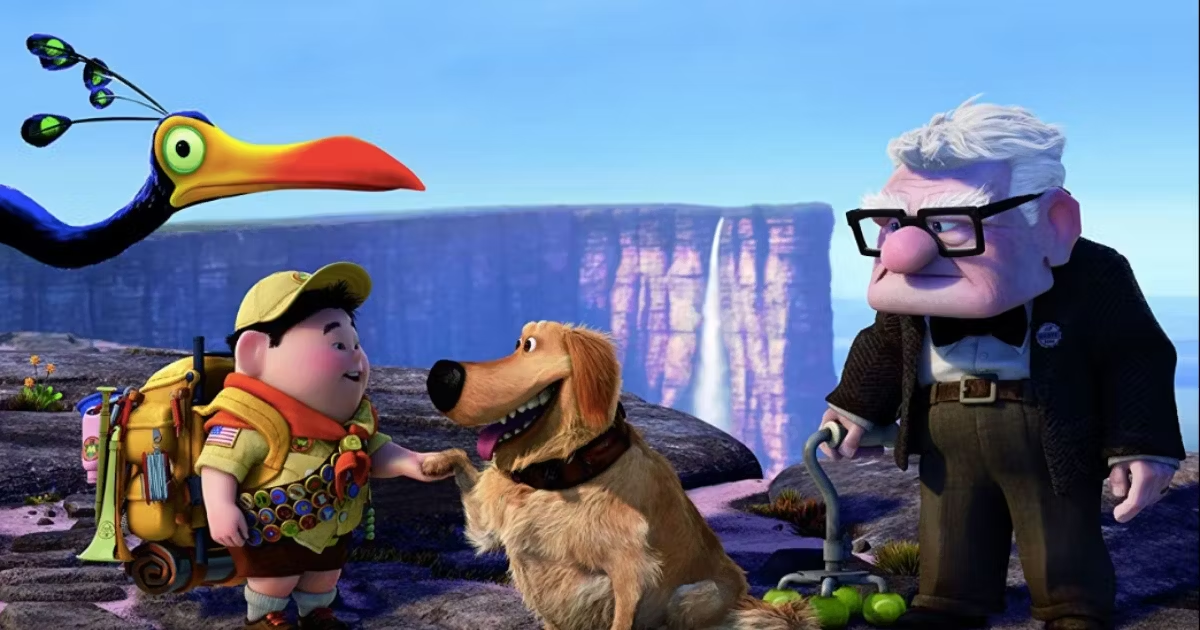
The terms “older adult” or “later life” feel somewhat distant to me since I see myself in the first quarter of my own life. I picture “older adulthood” as beginning around the age 60 or 70. I imagine it as a stage where people may retire if they choose and reflect on their lives, their accomplishments, and their relationships or continue their careers and try new things. Society portrays aging as something to resist or avoid, but in reality, it’s an inevitable part of life, but it doesn’t have to be a negative one. A fun example of this is portrayed in the Pixar movie Up. The first 10 minutes of the film focuses on the characters younger years, but the other hour and 20 minutes of the movie follows Carl (the main protagonist) in his “later life” and he definitely does not follow the stereotype of decline in “older adulthood”. The story shows how old adulthood can be full of growth, adventure, and connection. Even though it’s a children’s movie, it shows that “later life” can hold as much meaning and possibility as any other state of life.
I think I will start to consider myself an older adult in my late 60s or early 70s. When I envision myself at that age, I imagine having gray hair, laugh lines, and most likely having some health issues due to my actions as a younger adult. I also envision myself continuing to work in the social work field and spending my time with friends and family. I hope to keep up my knitting hobby from my 20s and maybe volunteer at an animal shelter. I also see myself traveling and seeking out new experiences since I would likely get bored doing the same routine daily.
One aspect of agent that I fear is the possibility of social isolation and cognitive decline. The possibility of losing the ability to connect with others and experiencing memory challenges is concerning because it impacts my overall quality of life. I am a very social person and value human connection so I know that I would do everything I could to combat these issues by continuing to participate in extracurricular activities such as joining a knitting group and continuing my membership with the choir I am currently part of. If I were to experience these challenges later in life, I hope I would have access to a memory care facility where I could receive proper care and also connect with others facing similar challenges.
Thinking about aging in later life has helped me reflect on both the opportunities and challenges that come with it. Even though aging is inevitable, it can also be a time of growth, connection, and fulfillment. In this class and through my classmates’ diverse experiences and perspectives, I hope to gain the knowledge and skills needed to better support my future older adult clients in navigating the challenges of aging. I’m excited to continue to explore what it means to age for both myself and for my future clients.
Hi Gianna, I am also a social work major; this is my senior year, as I work towards obtaining my bachelor’s degree. Our posts shared many similarities, particularly in their approach to the concept of aging. Society often instills fear of getting grey hair and wrinkles and continues to promote numerous collagen boosters and cosmetic creams, lotions, and products to halt an inevitable process. Everyone has to age whether they want to or not, and no amount of product can stop or change that. I’m glad you also have the perspective of looking at it again as something beautiful, not fearful, because it shouldn’t be perceived that way. I also relate to the cognitive challenges that often accompany aging. I value my memories greatly, so not being able to reconnect with them again would be devastating. Great blog post!
Hi Gianna,
As a fellow Disney fan, I have to admit that the mention of “Up” immediately caught my attention and pulled me into your post. That film is such a beautiful (and emotional) reminder that later life can still be filled with adventure, growth, and meaningful connections. I love how you tied Carl’s story to the idea of aging not being about decline, but about all the possibilities. It makes the topic feel more relatable.
I appreciated how you described “laugh lines” instead of wrinkles. That framing feels so much more positive. It highlights how aging can carry the story of joy rather than just being seen as loss…of collagen. It made me reflect on the language I use and how even small shifts in wording can influence how we view aging. Society sometimes focuses too heavily on the physical aspects of aging while overlooking the importance of purpose and identity. Movies like “Up” remind us that purpose doesn’t have an expiration date, we can continue to grow, give back, and even surprise ourselves well into later life.
Thank you for sharing your experiences and perspective, it was both entertaining and thought-provoking.
Hello Gianna!
This is my first semester in the MSW program. I believe I can connect to your post a bit. I also said that I would consider myself a part of older adulthood at 60. I mentioned wanting to be surrounded by my family as I enter my retirement years. I definitely understand your concerns for cognitive decline, as one of my fears was losing my independence, and this could be a way of doing so. It may feel like I am losing my freedom, dignity, and sanity all at once. Something I hope I never have to experience. Hopefully, my grandmother’s genes were passed down to me; she had a phenomenal memory. As future social workers, the word “social” is a necessity for us. So, the fear of social isolation, cognitive decline, and loss of independence, I believe, is a natural concern.
Gianna,
I have to admit I loved the photo. Thank you for sharing your thoughts and experiences. We all appreciate it. I am sure that your work as an ACT case manager has definitely informed your view of aging and your desire to support older adults with challenges. Kudos.
I find it interesting to hear you talk about all the interests you have right now – and how all you want is to take them with you into your own aging. It’s a really nice vision of our aging, isn’t it? There are many challenges, and you have raised several. Connection is so important for our mental health and that becomes more true as we age and become more invisible in our culture. I have frequently said that we need to redefine the word retirement – it’s not doing nothing, it’s doing what you want to do.
I look forward to more conversations. I think you will find the podcast interviews interesting, as well as the texts. we will be talking about society’s definition and the need to build our own village.
Dr P