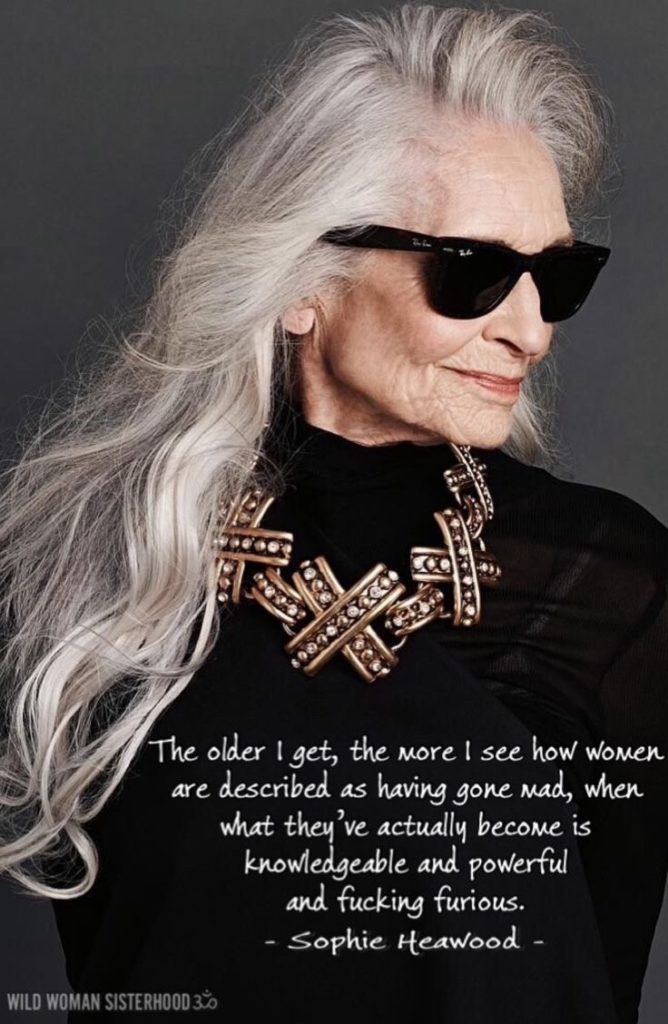

Ceridwen Dovey closes her article “What Old Age is Really Like” with a quote from the late Adrienne Rich (reflected in the title of this blog post) that I feel perfectly encapsulates the complexity of aging and the deeply rooted, negative impact of ageism on all generations. Each of our individual lives is a unique balancing act. The only constant is the passage of time, which happens whether or not we pay mind to it. The readings for this assignment analyze ageism through several lenses that impact people throughout the life course, including healthcare and media. This lifelong imposition of ideas has made ageism a pervasive part of how our society views older adults, especially older women.
I found the words of M.F.K. Fisher particularly heartbreaking. The way that she allowed her husband’s beliefs about womanhood to permeate her sense of self, even after his passing, struck me as a very common and harmful inevitability in the aging of women. He used the word cruelly to describe the way in which a woman should look at her body. She could regard herself with gratitude, admiration, love, or even just acceptance, but he had instilled in her the idea that she, too, must be the arbiter of self-judgment. This creates erosion of self from both within and outside the individual. Cruikshank is rightfully shocked by the paradox of Fisher’s sensitivity toward other people’s experience of aging vs her own. This section was most impactful because it reflects the prevalence of self-hatred that many women develop throughout their lives. The offhand comment made about her body or a TV commercial touting unrealistic beauty standards creates an internal narrative that influences the aging person’s true self-opinion. It can be easier to show grace to others, as Fisher did. From this part of the text, I learned not only about the various ways internalized ageism develops but also that we can take action against it. Earlier in this section, Cruikshank shares studies proving the powerful mind-body link. Stereotyping has been shown to have a profound impact on the aging person; modeling and encouraging positive self-talk can significantly enhance someone’s quality of life. Daily affirmations are being done in schools and can be a meaningful way for older adults to find a sense of self-efficacy.
A sentiment shared by both Cruikshank and Dovey is the idea that, at some point, older people become part of a melting pot. They are no longer the sum of their parts. The vastness and variety of their experiences no longer apply. Cruikshank’s time at the Montefiore Senior Center exemplifies how someone’s initial impression, often based on appearance, can influence the way an older person is perceived. The woman who made insightful comments during class, as well as the woman who had lived abroad and spoke Mandarin, are unique and complex individuals; the least interesting thing about them is the way their bodies have aged. The richness of an aging person’s life is informed by decades of trial and error, joy and pain, and so on. A valuable way to share the fullness of an older person is through storytelling. Film and television have the means to do this work. Still, as Dovey shares Juliet Stevenson’s experience of acting roles becoming less complex, while she and other aging actors are more equipped to tell rich stories backed by experience, not imagination and stereotypes.
We see many examples of internalized ageism throughout these readings. One that is not the most overt but that I find devastating is Aronson’s stroke patient, who didn’t call the after-hours emergency number. I know this section was meant to compare the lack of awareness in the young man and the over-awareness in the older woman. This segment was framed as the woman caring more about the doctor than herself, which is undoubtedly part of the situation and a common occurrence in a woman’s upbringing. I think the more pernicious factor here is that she may not have believed whatever she was experiencing was important. When people are ignored or invalidated, they begin to believe they are undeserving. This felt more about self-worth than caring for others.
A candid and understandable representation of internalized ageism comes from Fleur Adcock. Dovey shares that Adcock did not feel as though she was aging until serious illness struck when she was seventy. She hung onto middle age, likely unintentionally, but was later able to reflect that her experience had been “a very gradual process, with old age retreating and advancing unpredictably over the years.” (Dovey, 9) While this admission may be categorized as untidy, the truth behind it is crucial. It is the sudden confrontation with aging that can be so detrimental to an individual’s mental wellness. Understanding, acceptance, and care for oneself during this part of life is paramount, considering the varying ways people enter it.
A theme seen through each of the readings is the delegitimization of older people. This is often imposed on them by society in a seemingly endearing or humorous way, but the condescension is very present. Aronson’s focus on the word cute is one that I have seen reflected in my own life. My mother, who died just this year at 65, was 5 ft tall, though she would often wear shoes with a heel to give herself a little boost. She was so full of life and was often called cute by my nieces and nephews, who are all significantly taller than she. She was so much more than just cute. She was tenacious, imaginative, deeply spiritual, and carrying the weight of years of hurt. Yes, she was beautiful and with that cute but to diminish anyone to just that makes it a derogatory term. My mother would also use language like senior moment when she forgot something or called her church friends young lady, problematic language raised by Cruikshank. She provided home care for some ladies in her community and always did her best to encourage them to be fully themselves and to take up space. She hoped to inspire these women to embrace their uniqueness while still using language that works against their empowerment. She was stuck in the middle of trusting her gut, as a Puerto Rican woman who honored aging and individuality, and reflecting the American stereotypes that most of her peers had grown up in. As a writer, Dovey understands the power of language and has been able to reflect on her own misguided understanding of what aging entails. The tropes on which she created her aging characters did not serve her as a writer or the community that she was looking to illuminate. She did something that I find admirable, which is to step back from the work and learn from sources who understood both writing and had a lived experience. This showed her respect for how older people are reflected in creative forms and for art in acknowledging the accuracy with which it should reflect life.
As disheartening as it was to hear how people reacted to Aronson’s career, the fact that geriatricians often have high career satisfaction says enough for me. Focusing on work that she is passionate about and caring for a demographic that deserves far more respect than they receive sounds like a career worth waking up for every day. I came to this class because of my interest in the topic of grief. Having lived long and full lives, older adults have experienced a multitude of ups and downs over the decades. Natural disasters, poverty, discrimination, and violence are just some examples of what people might face throughout their lives. This doesn’t take into account the interpersonal relationships that weave us all together. The loss of a job, a home, a child, or a grandparent impacts people’s lives in immeasurable ways. I did not take this class because older adults are nearing the end of their natural lives and therefore must be grieving that experience, but rather to understand how these full lives interact with being in the third act of their lives, as Aronson calls it. As a theatre major, I can acknowledge the importance of each point in the arc of someone’s story. The major issue that came up for me in this assignment is the erasure of the individual. So often, older people are not allowed to integrate their lives before (in youth) with their current lives (in old age). I believe a key way to help older adults feel like they have lived a whole and valuable life, regardless of their economic status or other externally defining factors, is to create spaces where they can openly share their experiences without judgment. We’ve seen reflected in the readings that even among their peers, older people are judgmental of each other and create a hierarchy based on ageist standards. Self-acceptance and validation can help break these barriers, giving people the space in their own minds and hearts to cultivate self-love and, hopefully, peace with how their lives have brought them to where they are now.
Aronson, L. (2019). Elderhood: redefining aging, transforming medicine, reimagining life (1st ed.). Bloomsbury US Trade.
Cruikshank, M. (2013). Learning to be old: gender, culture, and aging (3rd ed.). Bloomsbury US Non-Trade.
Dovey, C. (2015, October 1). What old age is really like. The New Yorker. https://www.newyorker.com/culture/cultural-comment/what-old-age-is-really-like
Your reflection is incredibly empathetic, and it reads beautifully. I especially appreciate how you highlight the internalization of ageism, not just as something imposed externally, but as a quiet erosion of identity that can shape a lifetime of self-perception. I also think you made an important distinction in the stroke example from Aronson. It breaks my heart that it is about gendered social conditioning around caretaking, but you expand it thoughtfully to include self-worth and deservingness, which is such a key point. When you mentioned that ignored people begin to believe they are undeserving, it resonated deeply, especially in older adults absorbing decades of subtle dismissal, infantilization, and being “talked around” in healthcare and life.
I’m really sorry to hear about your mom. Your writing about her is so eloquent, and she sounds like a force to be reckoned with. It also illustrated the contradiction many people face: honoring aging in others while unintentionally adopting the language and attitudes that limit themselves and their peers. That tension feels real and relatable. The term “cute” in particular, framed as affectionate, yet ultimately diminishing, perfectly captured how seemingly harmless language reinforces ageist hierarchies.
Helen,
Thank you for this essay. It was excellent. I too was totally taken aback at the Fisher story of looking at herself in the mirror to see herself as ugly. it took me awhile to absorb that one myself. I am sorry for the loss of your mother at such a young age. I think it’s always hard to lose our mothers, no matter the circumstances. She sounded like quite a spark plug.
I learned when I was at Lifespan how easy it is to only see the older adult sitting in front of you and to not realize that inside there is an entire life, full of stories and experiences. Flattening the experiences of older adults into their present day reality is something we all tend to do and we need to fix that.
I find it interesting that the topic of grief is what lead you to this class. I regret that we didn’t get to spend as much time on those difficult conversations as I would have liked. I will be adding some material to this module in case you or others might be interested. There are so many moments of grief in our lives, and we have very few tools to help us know how to navigate them.
Thank you for sharing your analysis and experiences. This was well done.
PS: I LOVE THE QUOTE!!!
Dr P