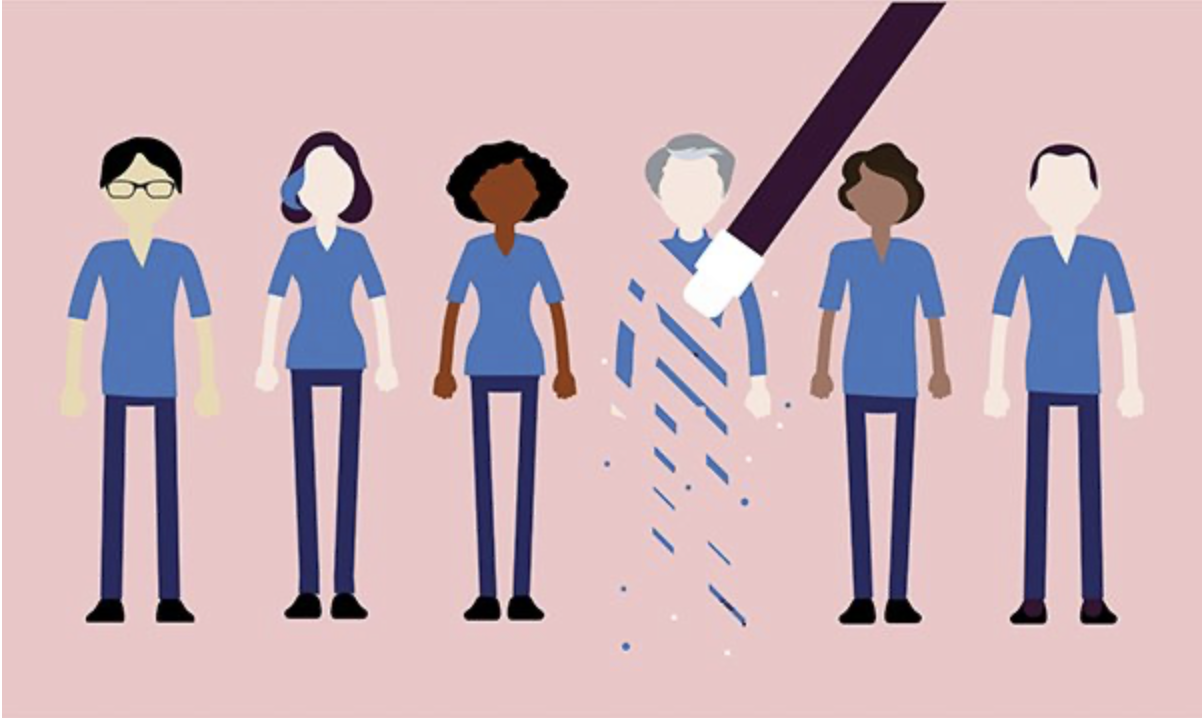

I felt very sad reading Eva’s story. I keep thinking, what if Aronson had not seen her or been there? How would she have gotten home and made her way back to her apartment and up the stairs? She is so vulnerable and yet the cab still leaves her, not wanting to deal with a complicated situation. I think of her living alone, navigating all those steps by herself, with arthritis, limited mobility, and a cane, and understanding why she wants to remain in the place where she feels at home. She is overly medicated with uncoordinated care and being put through many seemingly unnecessary medical appointments and procedures, without addressing the care she needs – pain relief, mobility support, transportation barriers, end of life decisions, isolation, and support for her daily activities. No one considered what she wanted for her life and what would help her to live optimally in her own home. The lack of training for her doctors and systemic failures of the healthcare system for individualized and coordinated care did not serve Eva or other elderly people. The limitations of the coding system and lack of recognition for the greatest risks for the elderly can cause them to feel unheard or invisible, until what is ignored becomes a crisis, leading to a nursing home or death. It’s sad that there are services available but those who need and deserve them most are not made aware of the things that could greatly improve the quality of their lives and safety (Aronson, 2019).
It taught me how far aging practice still has to go. All humans, but especially elders, need more time and care. They cannot be rushed and expected to be on the same timeframe as the young. More specialized, coordinated care is needed to fill the gaps in service for those who are older, redefining what a healthy outcome is for those nearing the end of life. More needs to be done to train doctors about this population and more education is needed to draw attention to the dangers of ageism in all levels of life, but especially in medicine. Geriatrics is a valuable field, and I hope they can find a way to draw more people into training. Aging needs a new narrative.
Folklore and fairytales are full of negative stereotypes of aging, especially old women. Women are portrayed as witches, familiar with the devil, bad luck, as energy vampires feeding off the young, and overstaying their welcome by living too long. These stereotypes are indicative of the patriarchal times of the witch hunts, in which women were only valuable in relation to a man. If a widow owned land, knew too much, or seemed selfish with her powers, she was deemed threatening and someone to be done away with or even murdered for not fitting into society’s mandated behavioral norms (Cruikshank, 2013).
As almost an antidote to the stereotypes, I really like Dovey’s passage about Penelope Lively, who confronted these stereotypes by writing from within the terrain of the old, as an older writer. She likens herself to a time traveler and pioneer, given the freedom to observe and listen, due to the invisibility of older age. Dovey calls her an anthropologist of old age, reporting back to us about how life really is for those in later life. Lively cautions that writers lacking the imagination to detail old age realistically shouldn’t write about them because it becomes an ethical responsibility, as stereotyping is a type of fictional abuse (Dovey, 2015). These stereotypes create narratives, which then frame reality and people’s perceptions of others. Older age needs a new narrative and who better to write it than those who are elder?
I thought Aronson’s story of her struggle with letting her gray hair grow in after decades of coloring was honest and telling. It was interesting that even as a Geriatrician, and someone who “should” have a more accepting attitude toward the biological changes of aging to our appearance, even she struggled with not wanting to appear old because of what it would say of her abilities, her professionalism, and sense of being current. And even when she did decide to grow it out, she felt it wasn’t an acceptable shade because it didn’t look glamourous like a silver fox or a new-age goddess, two acceptable looks for older women “redefining” aging. There is peer pressure for women to not look old, and not become “other,” opening oneself to ageist prejudice of relevance and worth based on a youthful appearance. Even though she wants to stop taking the time and resources needed to prolong the masking she is doing, she wonders if by trying to be more real and a living example of what aging could be, if it is brave or a mistake to operate outside of culturally accepted norms (Aronson, 2019).
In Dovey’s New Yorker article, she writes that as some people age, they feel younger internally than they may appear externally. The younger they feel increases as they age chronologically. This discrepancy on some level may serve to mentally distance oneself from the inevitability of aging and all that it may entail and to some extent, still feel relevant and youthful. She also talks about Freud’s horror and disgust at his reflection in the train window, seeing himself as elderly, rather than how he may perceive himself to be internally. And Lewis Wolpert’s wondering how the 17-year-old he feels internally could be 81 years old (Dovey, 2015). As one ages, it is normal to feel that time has passed too quickly but to feel horror does speak to discovering oneself to suddenly be in the terrain of what society calls old – irrelevant, out of touch, decrepit, and not valuable, and believing that to be true of oneself.
Cruikshank writes about how everyday phrases meant as compliments, such as “you look great for your age” or “young at heart” reinforce ageist assumptions because they imply that it is better to be young and we should strive to not become old and irrelevant, even though everyone will age inevitably. She also talks about how we talk to elders with language like what is used with children. We say “sweetie” or “dear,” talking down to them, further reinforcing that they are beneath us and not capable of being on our level. Even Gerontologists use language like young-old and old-old, inferring seeming distinctions between those who are still pretty together and those who are more decrepit (Cruikshank, 2013).
In the Dovey article, Dovey details the thoughts of Sarah Falcus, who speaks of the power of literature to shape social worlds and people’s thoughts, feelings, and perspectives of it (Dovey, 2015). Language is powerful and we should be careful of what we are saying because it shapes people’s perceptions and beliefs, which then impact the lived reality of different people, for better or worse.
To me, the most powerful example was Aronson’s analysis of how we speak euphemistically about nursing homes though everyone dreads them and feels guilty for using them for our loved one’s care. She talks about how families might say they sent someone back to the nursing home instead of saying that they are there because their care couldn’t be managed within the demands of family life. She makes the point that this language helps to let ourselves off the hook for our own culpability in an unhappy end of life, as well as the system that creates and maintains these horrible ethical dilemmas and situations in the first place (Aronson, 2019).
I have noticed that as I age, I have started to speak of myself as “old” in a preemptive fashion, as if to name it first, to prevent my hurt feelings. This says so many things. Why would my feelings be hurt by the fact that I’ve been on the planet longer? However, I do fear being seen as irrelevant, out of touch, having assumptions made about me based on my appearance, and losing opportunities. As part of my own work, I see that I need to work on having a better self-concept of aging for myself and for those who are also being impacted by ageism.
I found the lack of training for doctors regarding what older patients need, the lack of geriatricians, and the overall disregard that the medical system and society have toward a huge part of the population, that no one seems to notice, really disturbing. It is sad that this lack of information and failure to treat older people as needing different things, like how children cannot be treated as adults, is doing a lot of harm, killing older people prematurely and making their lives significantly harder than they need to be. There is no excuse for doctors to not involve social workers, or work in a coordinated team, to make sure the services available to the elderly are disseminated to them or their caregivers. As a result, society blames older patients for unexpected outcomes and challenges, instead of the system that dehumanizes, did not prepare them properly, did not allow time for proper care, and did not teach them to consider the special needs of this population (Aronson, 2019).
There is a huge disconnect between how older people are treated and truly understanding that at an advanced age, most people want to be comfortable and find ways to work around the limitations that keep them from enjoyment of their life and performing the daily activities they need to maintain independence. People, doctors included, don’t seem to know how to relate to older patients, either condescending, dehumanizing, or disregarding them entirely. It is heartbreaking to read about how many patients endure difficult situations like having to go out to appointments, get prescriptions, or maintain their house, with no one telling them what resources and services are available, such as caregivers, house calls, or prescription delivery. The unnecessary medical procedures performed because most doctors only think of medicine in heroic terms, extending life, instead of making life more humane and bearable. It is sad to see that the respect and trust that older people have for doctors is sadly not returned (Aronson, 2019).
In my practice, I would follow Zandra’s advice and give myself as much time as possible to hear what is being said and not said. I would give space and offer patience and presence. I would ask questions and make sure I understood instead of assumed. I would seek to empower and meet people where they are, having awareness of what they can and cannot do, encouraging them to stay independent. I would look for ways to stand in the gap, advocating for clients and providing information, questioning their care to make sure it is appropriate and mindful of their age and condition. I would advocate for them to make sure they have what they need to continue living the way they enjoy for as long as possible. If changes were needed, I would be sure to include and support them, advocating for what they need and want, involving family as wanted or needed. I would make sure to treat them as an individual and as an elder, someone who has something to teach me and has a lot of lived wisdom to offer and share.
References
Aronson, L. (2019). Elderhood: Redefining Aging, Transforming Medicine, Reimagining Life. Bloomsbury Publishing.
Cruikshank, M. (2013). Learning to Be Old: Gender, Culture, and Aging (3rd ed.). Rowman & Littlefield.
Dovey, C. (2015, October 1). What old age is really like. The New Yorker. https://www.newyorker.com/culture/cultural-comment/what-old-age-is-really-like
Elaine,
This is a wonderful post! I enjoyed reading all of your take always from the articles – Lively is indeed a time traveler – as you can tell if you read any of your works. And just so you know, in a study asking older adults how old they fell they are, as opposed to their chronological age, most of them “see” themselves as at least 20 years younger. I’m not sure that is always about avoiding aging or the discrimination of aging, as much as it is the fact that we take that younger person along with us as our bodies get older. We know the things our body used to do – so we can realistically see it at 20 years ago.
I was particularly impressed by your last paragraph, and I know Zandra would be as well. You will be an amazing social worker, and it is my sincere hope that you have the opportunity to work in settings where you can do at least most of what you aspire to do.
Dr P