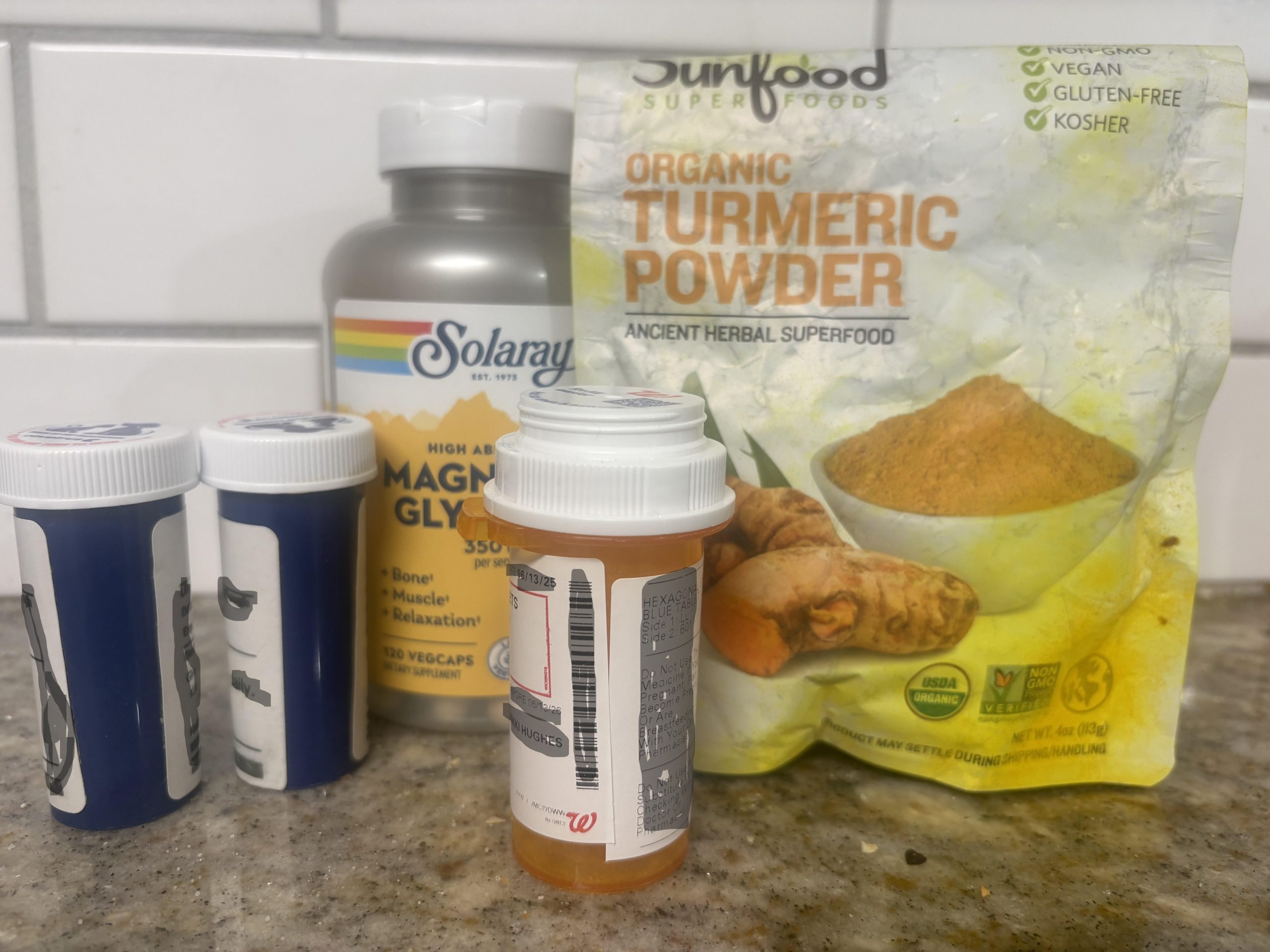

My post this week has a photo I’ve taken from my treasure trove of aids that older adults may utilize in the home. One particular point I’ve made is two of these are for my dog, who is a 16 year old little lady who’s slowing body, seizures, and desire to “remain young,” is seen as she tries to keep up with our puppy who is much bigger. As we age, I hear others say “I can’t handle keeping a dog anymore,” due to the desire not to be pinned down, or the difficulty of taking care of one. Now on to this week’s questions.
- What fact about medication and older adults surprised you the most – from either text? Please elaborate as to why you were surprised. I believe the aspect with medication and older adults which surprised me is how very complicated it has become to diagnose adverse effects, now that there are so many medications, and many age-related effects on the body are similar as some of those side effects. I had heard there were many errors in healthcare, but I was shocked as to how much of that error happens because physicians have struggled to keep up with notices from the FDA, and the effect of bodily changes with aging. Our progress medically has become a catch 22. New medicines create new side effects. New products in our environment manufactured to make life easier or to help us do things faster have made the world more toxic, such as what happened with asbestos, with saccharine, and artificial ingredients in foods that harm health. Now we hear that bacon, butter, honey, and foods that have not been manipulated genetically or coated with pesticides make us healthier. In medicine and in food, industries have been chasing the dollar and putting patient or client’s interests last. I like what Aronsson says about how the Puritans saw the body as sacred, in comparison to how industry sees it as a machine that can make them money. The term itself House of God, reminds me of the description of the body as a temple that must be properly respected and treated with great care. It is easier to cherish a person who you believe to be a blessing. Great care comes out of loving one another.
- Cruikshank talks about the natural changes that occur in our bodies as we age. Some of these changes are why drug reactions occur. What did you think of her analysis and her solutions? I am overwhelmed by the complexity of what Cruikshank has said that can happen because of reactions and also the effect of aging changes in the body. (Cruikshank, 2013) Added to that is the biogenetic differences in race, and how those differences can affect interactions. (Id.) I agree that more research needs to be mandatory for alternative sources such as herbs, vitamins and healthy food. There needs to be more oversight of this area, and ethical research must be done. Right now, there are many “natural remedies” pushed online which are possibly harmful to many who are desperate for energy, vitality, weight loss, treatment of diabetes, and other effects of aging. Too many charlatans are on the web touting such claims as “these three ingredients in your refrigerator” can do miracles and you don’t need to see your doctor, dentist or eye doctor again. In these ads, the business is using fear appeals because they know it sells. (Tannenbaum, et al. 2015). This is very dangerous. If more researchers took alternative medicine seriously and conducted great research, which would then be ethically regulated by agencies, there could be a much better result for everyone, including the elderly. If more healthy food were available, it could bring the cost down to a more affordable level. In my opinion, food supply is the most basic and easily controlled way to make positive changes in health.
Tannenbaum, M. B., Hepler, J., Zimmerman, R. S., Saul, L., Jacobs, S., Wilson, K., & Albarracín, D. (2015). Appealing to fear: A meta-analysis of fear appeal effectiveness and theories. Psychological Bulletin, 141(6), 1178–1204. https://doi.org/10.1037/a0039729
How did her discussion inform you about your fears of growing older? Americans all fear getting older and big pharma uses that factor to sell drugs. Madison Avenue knows the effect of using fear in advertising. I had seen this for a long time, and knew this, but did not know that we are not being told the complete picture. The fact that the FDA does not require companies to re-approve drugs and is not holding the industry accountable enough is frightening. (Cruikshank, 2013) I know there are tons of regulations about prescribing drugs, labeling of food, but regulations are hard to enforce. Regulations take time to develop, and public comment on them is only available for short windows of time. Most people do not know that you can comment.
- Aronson uses patient examples to make her point about medication and the power dynamic of physicians. What did you think about her conversation with Irina, Dimitri’s daughter? Irina and Dimitri had been conditioned to trust all physicians. This happens in many cultures. As a paralegal, I understand the relationship between patients and doctors is similar to that of an Attorney and their clients, as a fiduciary. According to the American Medical Association, “the relationship between a patient and a physician is based on trust, which gives rise to physicians’ ethical responsibility to place patients’ welfare above the physician’s own self-interest or obligations to others, to use sound medical judgment on patients’ behalf, and to advocate for their patients’ welfare.” (American Medical Association, 2025).
American Medical Association. Medical Code of Ethics Opinion 1.1.1. Patient-Physician Relationships, AMA Principles of Medical Ethics: I,II,IV,VIII.
https://code-medical-ethics.ama-assn.org/ethics-opinions/patient-physician-relationships
Likewise, in the social work setting, we are bound to an ethical standard to keep our practice client centered, culturally appropriate, and that would mean not missing something that affects client safety, health, and stability. In my past work as a Realtor, I have been a fiduciary, with a duty to act in the interest of my client’s benefit first above my own, within the law and rules of ethics.
- Aronson also discusses some of the issues related to dementia in the final section of this chapter. In thinking about the Memory Loss Tapes, how did her discussion add to the information you learned there? What do you think about the issues with her talk about dementia at the conference? In the Memory Loss tapes, there was a great explanation of the differences in phases of a spectrum of dementia. Aronson further explained that dementia can have more than 70 medical causes! (Aronson, 2013) Aronson explained, 30 years ago we did not know the term Alzheimer’s. (Id.) There was great discussion about clinical practice supporting families, helping everyone involved understand the changes a person would go through as part of their identity would die. (Id.) The conference leader certainly was unaware of the nuances related to clinical care and the need to discuss that versus or in relation to the value of medical research on treatment of patients with dementia. (Id.) Her discussions have illuminated how the mere cascade effect of medications can cause side effects that look like dementia. (Id.) I had the impression before reading Aronson’s chapter only of the general diagnosis spectrum but not the complexity presented by the lengthy number of factors which creates immense risk to older adults with the addition of each medication.
5. Aronson’s example of Gabow’s mother showed an excellent example of what Cruikshank described in alternative approaches. What did you think about that example? What had the biggest impact on you? Dr. Gabow exercised great courage and advocacy on the part of her mother in making the decisions needed at the time. It is interesting that since she had completed her mother’s Advanced Health Care estate planning, she knew her mother’s wishes, and that led to a better outcome for her mother. Most people do not know about Advanced Directives, and Durable Power of Attorneys, although there is free legal assistance for this available in some metropolitan cities through Legal Aid societies and from law school students, or other non-profit centers. A person can get legal aid for help with Wills, and these basic Estate Planning documents. Attorneys I know add that a will without the other two documents is insufficient, and malpractice if not also done. I have also seen for several years how the medical industry has been focused on disease, and has ignored many practical issues such as nutrition, mental health, patient social and economic factors, and other clinical facts about patients in informing treatment. I did not know that most of the industry had become so robotic in practice. (Cruikshank, 2013).
I really enjoyed reading your post this week. I thought it was creative how you started with the example of your dog—it made the connection between aging, independence, and care very relatable. I also appreciated how you tied in not just Cruikshank and Aronson, but also broader issues like the role of advertising, food industries, and fear-based marketing. The point you made about “progress becoming a catch-22” really stuck with me, because it shows how complicated medical and food advancements can be when profit is prioritized over people.
you brought up so many important points, I totally agree that the complexity of medication reactions in older adults is overwhelming. I was also shocked to learn how often drug side effects are confused with age-related symptoms, and how little oversight there is for natural remedies online. It’s scary how much fear is used in both medical and food marketing, like you said, and I hadn’t realized how much that influences public trust.
Libby,
It is difficult for physicians to stay on top of the many medications prescribed today. One of the most important things they can do is pay attention, right? I was speaking with my gerontologist recently, and she said that many of her patients don’t bring in their medications when they have appointments, even though she always asks them to. That is one of the most important ways to learn things that your patient may have forgotten to tell you and have a full account of what the patient is taking.
You point about trust between doctors and patients is well taken. Likewise, the importance of questioning our physician is equally as important. This is often a generational issue, and I will be interested in seeing how younger generations approach this issue as they age. We are faced with a paradox here, in some respects, right? We need our physicians because we are not medically trained and we don’t know all the answers when we face an illness. However, we need our physicians to take us seriously and listen to us when we tell them our experience may be different from what they have learned. We challenge our physicians and then have to trust them in the end for important answers. I have come to believe that the best way to address these ethical issues you raise, whether a physician or a social worker, is to see the relationship as a partnership and to be aware of the power differential between us and our clients.
I think the standards of care that Gabow spent time developing were more to prevent the neglect of care we have been talking about earlier. It is a best practices issue, and we support that in our profession as well. But she realized, almost as a surprise to herself, that sometimes that standard isn’t the best solution.
I agree that most people do not understand the importance of legal documents as they age. And typically, they don’t have them because they and their families aren’t willing to have the difficult conversations. I hope we have a panel discussion at the end of the semester about difficult conversations.
You did a very nice job on this post. Well done and complete.
Dr P
PS: We had many bottles of medicine for our 14 year old lab Sunny on our counter as she battled kidney disease, so I truly know that experience.