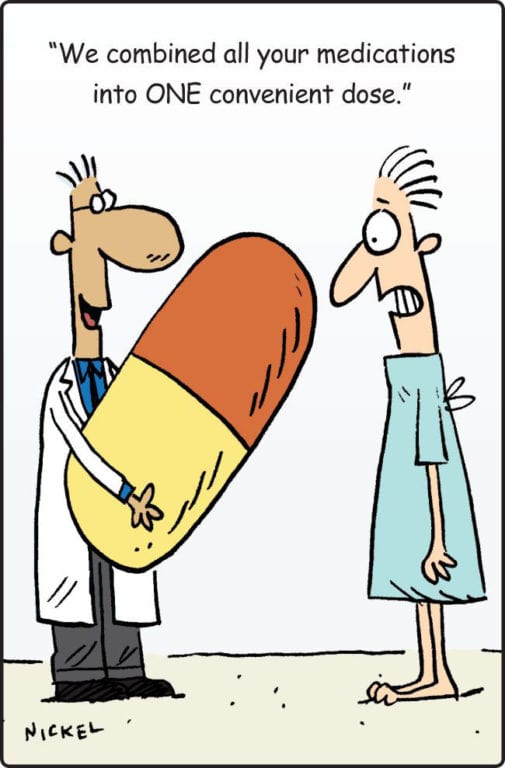

Unfortunately, I am not very surprised by what Cruikshank (2013) discussed in Chapter 4 on overmedicalization. Many aging adults are treated as though every ailment needs to be corrected, when honestly, I do not think that is true. And often many of these ailments are caused by the drugs being prescribed to them. Something that does still surprise me, even though I have seen it time and again, is the audacity of big pharma, insurance companies, and drug companies. It seems comically evil, in a sense, how they put Americans in debt while still not actually providing them the most accurate and necessary medications and treatments. Many doctors tend to prescribe medications without taking into account a person’s entire environment and well-being. However, I do not want to place this issue directly on providers because it is a systemic problem. This is why the biopsychosocial model works well when trying to assess what could benefit a patient and what could harm them due to an outside factor. Cruikshank (2013) mentions how side effects from overmedicalization are a main reason for loss of balance and falls in older adults. Falling is one of the most dreaded aspects of being an older adult. Because a fall that maybe you could have brushed off in the past could put you in the hospital for weeks or even months in older adulthood.
I think it is so interesting how easily Aronson (2019) found the information through his daughter that she needed to determine that Dmitri may be overmedicated. Many healthcare workers are overworked and more focused on treatment than discovering the reason behind every side effect or ailment. However, in this scenario, that ended up harming the patient. I think that her conversation with the daughter was handled well. Though these are more preferred to be done in person, in this case it is good that she brought this up earlier. The daughter, though well-intentioned, did not have the knowledge to suggest that maybe her father was being overmedicated. This is the case for a lot of people simply because there are a lot of advancements in medication and treatment each year, and they are putting trust in who they have been told knows the answers. It is good that Aronson decided to call the pharmacy immediately after the call with his daughter. This is a good example of integrated care and the benefits that it can have on a patient’s well-being.
Though I mostly agree with what Cruikshank (2013) means when she says “ alzheimers stands for aging in America” (Cruikshank, 2013). However, I think that is too broad of a statement. In everyday life, I generally don’t believe that everyone considers aging to be dementia or the end for them. I want to say that Americans have moved past that mindset, but with more information constantly available and a growing need for caregivers, the fear of dementia is still highly prevalent. So honestly, I am not sure whether I believe that alzheimers stands for America or not; hopefully we can decrease the stigma around it over time, which we have done over the last 20 years or more.
This article by the National Library of Medicine (2021) discusses somewhat recent findings related to the overmedicalization of older adults. As the population increases and continues to do so, there is a stronger need for geriatric medical providers, and it has also encouraged pharmaceutical companies to advertise heavily to this growing group of people in the U.S. Many other countries have disallowed medication advertisements and have more regulations on the pharmaceutical industry, which could help alleviate this problem. The article discusses the age-related changes that need to be taken into consideration when prescribing medications to older adults. In addition, medications can have stronger effects in older adults, and they may have age-related symptoms that could worsen due to a medication, much like Dmitri in many ways. I am glad that this research is being done to some extent, and hopefully we continue to think more about our overmedicalization in the future. This could be achieved through bringing awareness to older adults and their children throughout this process. In addition, advocated for universal healthcare that would take some power away from pharmaceutical companies.
References:
Aronson, L. (2019). Elderhood: Redefining aging, transforming medicine, reimagining life. Bloomsbury Publishing.
Barry, H. E., & Hughes, C. M. (2021). An update on medication use in older adults: A narrative review. Current Epidemiology Reports, 8(3), 108–115. https://doi.org/10.1007/s40471-021-00274-5
Cruikshank, M. (2013). Learning to be old: Gender, culture, and aging (3rd ed.). Rowman & Littlefield.
Hey Morgan!
I really liked your point about how overmedicalization is not always just an issue of individual providers, but can be connected to the larger healthcare system. Your discussion of Dmitri also stood out to me because it shows how important communication between healthcare providers, patients, and family members can be. Sometimes family members may notice changes that providers do not because they see the person in their everyday environment. I also agree with your point about the fear of dementia. Even though there is more awareness and understanding today, I think the fear surrounding dementia can still shape how people view aging and may contribute to seeing normal changes in aging as something that needs to be medically fixed.
Thank you, Ashley! I really want to emphasize that healthcare workers suffer many of the same setbacks that social workers see in their practice, and that they cannot always control what is happening with their patients. This especially happens with older people or those with chronic illnesses who may be seeing multiple doctors in different specialties who are not communicating with each other. This is how the system is set up, so I always try to look at the bigger issue that is causing prescribers to continue this pattern.
Hi Morgan! I found it very interesting that you interpreted that Aronson received that information “easily”. Here I was thinking to myself that this doctor’s approach was profound, but you are absolutely right- she did obtain that information easily by asking simple questions. Thank you for your comment, it actually made me challenge my own beliefs about medical practice and doctor-patient interactions.
Hi, thanks so much for your comment, and you’re welcome! I saw this so often while working with older people experiencing cognitive decline. The constant upage of dosages at any sign of aggression, and people taking up to 10 different medications that their families do not even understand. I do not know much about medication prescribing and how each of these medications works, but I think that our healthcare system needs a lot more funding and training on lessening drug prescribing and taking back some of the power that has been handed over to insurance and pharmaceutical companies. This is a huge task, but hopefully classes like this can be transferred into medical and pharmaceutical education as well.
Thanks so much:)
Morgan,
You and I both agree with Cruikshank and Arosnon that not every “problem” of aging requires a “cure.” As social workers, we are committed to a psychosocial approach to evaluating all our clients, including older adults, so we’re on the same page as well.
I think the problem comes in when we try to figure out how we got here. While I agree that the health care system is at the core of our present set of circumstances, there are so many other societal and cultural factors that weigh in as well. If you believe that a segment of our society is “less than,” you don’t work as hard to figure out the problem. I thought of the example in Aronson of the doctor who didn’t plan to spend much time with a patient when he thought the patient was old, but suddenly changed his schedule when he realized the patient was young. His solution was to make the patient’s age more prominent on the chart. That is about societal value.
Unfortunately, in our broken health care system, these societal definitions are the perfect condition for profit and power to disrupt a system that could work very differently. I care so deeply about this class because finding the right information actually doesn’t happen very easily. It happens when you understand the right questions to ask and how to ask them. Aronson got the information she needed from Dimitri’s daughter because she took her questions a step further and knew what to look for. That is a skill we develop with practice and work with clients – no matter what population we wish to serve. I suspect you are a step closer than most of your classmates because you spend time with older adults in your work and in your family. But we do train that out of doctors with the way we teach them to work with patients.
More Gerontologists are critical – I am with you on that one! Unfortunately, that isn’t the specialty everyone chooses – just like social workers and aging practice. But I also think really good family doctors and general practitioners can be part of this solution as well. Coordinated care for older adults is an important addition. That means developing primary care doctors for older adults who know about older adults. They may not be gerontologists, but they know who to ask and how to get that information. I can’t tell you how many of the older adults I worked with have no primary care physician – or at least not a good one. I also think overmedication is a significant problem in centers and communities. And that is about the management of a population of people in a single place.
Your article was a literature review on polypharmacy in older adults. I found the critical areas they raised interesting, but the most important part of the article, to me, was the discussion of models to consider when prescribing for older adults. It would be interesting to look at some of the promising ones, but because it was in 2021, they have probably moved past them. I also think it’s interesting that most of the models they discussed are from the UK.
Dr P