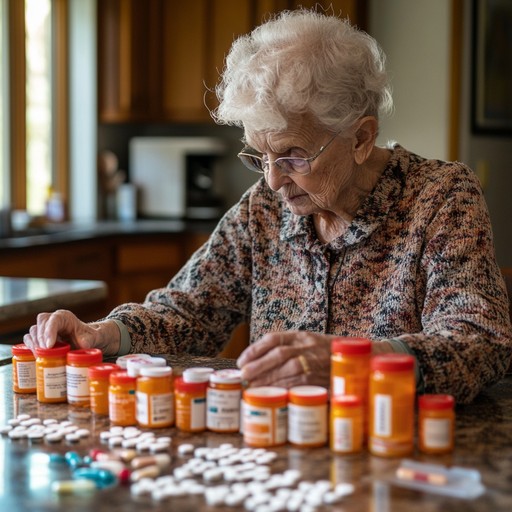

What surprised me most about Cruikshank’s discussion of overmedicalization is how common the practice seems to be in healthcare. What is most peculiar to me is that we have almost normalized older adults taking a large number of medications. Why is it considered okay for our elders to be prescribed so many medications simply because they are older? Cruikshank challenges this same assumption when she questions whether older adults actually need as many medications as they are prescribed and whether we have been conditioned to believe that multiple drug use is just a normal part of aging (Cruikshank, 2013).Cruikshank discusses how older bodies can be especially vulnerable to medication because metabolism slows, the stomach lining weakens, kidney and liver function changes, and certain drugs can remain in the body longer. She also explains that adverse drug reactions can include symptoms such as dizziness, fatigue, confusion, memory problems, and mood changes (Cruikshank, 2013).
I remember being a student on clinicals at a nursing home, and it seemed like everybody had at least ten pills to take. At the time, seeing all those medications was just part of the routine. They passed medications around, and that was it. Looking back now, I wonder why that seemed so normal. Were all of those medications still necessary? Were some treating side effects caused by other medications? And when an older person became sleepy, confused, weak, or less active, how often did we assume it was just because they were getting older instead of questioning their medications?
That information made me think even more deeply about what I witnessed in the nursing home. Sometimes it felt as though some residents were so heavily medicated or sedated that they became easier to manage. I cannot say that healthcare professionals were intentionally giving medications to make people age faster or to make their jobs easier, but I can say that this is what it sometimes looked and felt like from where I stood. Cruikshank made me question whether medication can sometimes become a way of managing older people instead of truly caring for them.
Aronson’s story about Dimitri emotionally triggered me. His story reminded me of some of the older adults I encountered while working in healthcare. When he entered the nursing home, he was taking ten medications and was barely speaking, eating, moving, or interacting with people. It would have been very easy to look at him and say, “He’s old. He has Parkinson’s and dementia. This is just what happens.”
But Aronson did not accept that explanation. She talked with Dimitri’s daughter and discovered that he had been healthy only a year earlier and, just six months before, had still been walking, talking, and reading the newspaper. That information caused her to question his medications. She discovered that he had experienced a prescribing cascade: one medication caused a side effect, another medication was prescribed to treat that side effect, and then another medication was added for the next problem (Aronson, 2019).
This part is actually emotional for me because it takes me back to something I experienced while doing clinicals at a nursing home. I remember being told that there was a resident who was very combative and difficult to deal with, especially when it was time for his routine medications. One day, instead of accepting that description, I sat down with him one-on-one. We talked for a few minutes, and eventually we started talking about his medication. He told me, “I keep telling them I am not taking that medicine. It makes my head hurt really bad.”
That conversation changed how I saw him. I realized that what everyone called “combative” behavior may have been this man trying to communicate that something was wrong. He was refusing medication because he believed it was causing him severe headaches. I went to the charge nurse and told her exactly what he had told me. She told me I cared too much and spent too much time with each patient. His complaint was basically dismissed.
That experience has stayed with me because, by the time I finished that semester, the resident had died from swelling in the brain. I want to be very careful here because I cannot say that the medication caused the swelling or his death, and I do not know whether the headaches were medically connected to what eventually happened. What I do know is that he was telling us that his head hurt badly, and he did not feel like anyone was listening to him. I have always wondered whether things might have been different if his complaints had been taken seriously and investigated.
Aronson listened. She asked questions. She did not automatically label what she was seeing as old age or accept his existing treatment simply because another physician had prescribed it. In Dimitri’s case, that willingness to question his medications made an incredible difference. After Aronson stopped eight of his medications and gradually reduced the other two, Dimitri began sitting up, talking, eating more, and moving better. Eventually, he left the advanced dementia unit and moved into assisted living, where he started painting, became involved in the residence council, and rebuilt his social life (Aronson, 2019).
It makes me wonder about the power physicians and other healthcare professionals have over an older person’s quality of life. With Dimitri, they used that power to reevaluate his medications and improve his quality of life. It makes me wonder how many other older adults might have a better quality of life if someone followed up on their medications, monitored side effects, listened when they said something didn’t feel right, and made adjustments when needed.
My experience also makes me question the labels we sometimes place on older adults. What does “combative,” “difficult,” or “noncompliant” really mean? Sometimes what healthcare workers see as difficult behavior may be an older adult’s only way of saying, “Something is wrong. Please listen to me.” Aronson’s story makes me think about how different an outcome can be when someone actually does listen.
Dimitri’s story represents exactly why healthcare professionals cannot automatically accept decline as “just old age.” Medication can be necessary and lifesaving, but more medication does not automatically mean better care. Sometimes caring for an older adult may require something as basic, but as important, as sitting down, listening to what that person is trying to tell us, and being willing to question whether the treatment itself could be contributing to the problem.
When Cruikshank says that “Alzheimer’s disease stands for aging in America,” I think she means that when many people think about getting old, one of the first things they fear is losing their memory. We hear so much about Alzheimer’s that sometimes it feels like people expect it to happen just because someone gets older. Cruikshank explains that all of this attention can actually make people afraid of getting old (Cruikshank, 2013).
What surprised me is that Aronson admits she used to think this way too. She thought that if you lived long enough, eventually you would become “senile” and lose your memory. Later, she learned that dementia is not something that automatically happens because you get old. People can live into their 80s, 90s, and even 100s without having dementia (Aronson, 2019).
I think Aronson views dementia differently because she focuses on the person first and the diagnosis second. I really like that approach. Just because someone has dementia does not mean we should blame every problem they have on dementia. Dimitri showed us that. Some of the things happening to him looked like he was getting worse, but his medications were actually part of the problem.
I think we are doing a little better today, but we still have work to do. We still joke about having a “senior moment” when we forget something. If an older person starts forgetting things, people may quickly think, “Oh no, is it Alzheimer’s?” That tells me we still connect getting older with losing your memory.
The biggest takeaway from both authors is that a diagnosis should not erase the person. Cruikshank notes that people with dementia can still enjoy things like music, painting, dancing, and other activities (Cruikshank, 2013).
A person may forget your name. They may forget where they are. They may need help doing things they used to do on their own. But they are still a person. They can still feel love, comfort, fear, happiness, and connection. Instead of always focusing on what dementia has taken away, maybe we need to pay more attention to what is still there.
The article I chose was “Deprescribing in Older Adults With Polypharmacy” by Hung, Kim, and Pavon (2024). What I learned from this article is that taking a lot of medications is still a real problem for older adults today. Polypharmacy is commonly defined as taking five or more medications, and the authors explain that it can be connected to side effects, drug interactions, problems with thinking and functioning, falls, hospital stays, and other health problems (Hung et al., 2024).
What really interested me was deprescribing. Basically, deprescribing means going back through a person’s medications and deciding what is still needed and what may need to be reduced or stopped. The goal is not just to take medicine away. Some people really do need several medications. The point is to make sure the medications are still helping the person and not causing more harm than good.
This connects directly to Cruikshank and Aronson for me. Cruikshank made me question why it has become so normal for older adults to be on so many medications. Aronson showed us through Dimitri what can happen when someone finally stops and looks at the medications instead of assuming everything that is wrong with the person is because they are old or sick.
The article also made me think about my own experiences in healthcare. Who is responsible for going back and checking all of these medications? If an older person has been taking the same medications for years, who stops and asks if they still need all of them? Who is paying attention when they start sleeping more, falling, becoming confused, complaining of headaches, or just not acting like themselves?
One thing I still question is how often medications are actually reviewed once an older person is placed in a nursing home or long-term care facility. Are we really listening when an older adult says a medication is making them feel bad? Or are we sometimes too quick to call them difficult, combative, or noncompliant?
After reading Cruikshank, Aronson, and this article, I think one thing is clear to me: we have to listen more and assume less. Older adults deserve to have their medications reviewed just like anyone else. They deserve to be asked how the medicine makes them feel, and they deserve for someone to notice when something changes. Sometimes improving someone’s quality of life may not mean adding another medication. It may mean taking a closer look at the ones they are already taking.
Aronson, L. (2019). Elderhood: Redefining aging, transforming medicine, reimagining life. Bloomsbury Publishing.
Cruikshank, M. (2013). Learning to be old: Gender, culture, and aging (3rd ed.). Rowman & Littlefield Publishers.
Hung, A., Kim, Y. H., & Pavon, J. M. (2024). Deprescribing in older adults with polypharmacy. BMJ, 385, e074892. https://pubmed.ncbi.nlm.nih.gov/38719530/
doi: https://doi.org/10.1136/bmj-2023-074892
Brittany,
Your experience with the resident who was labeled “combative” really stayed with me. You took the time to ask why he was refusing his medication, and he shared something important about how he was feeling. Being told you cared too much must have been difficult, especially when you were trying to make sure his concerns were heard. I also appreciate how carefully you explained that you cannot know what caused his death. His pain still deserved attention, regardless of whether it was connected to what happened later.
Your point about listening more and assuming less connects so well to Dimitri’s story. Labels like “difficult” or “noncompliant” can keep us from asking what someone is trying to communicate. As future social workers, we need to question those labels and help older adults have a voice in their care. Your post reminded me that taking someone seriously begins with something simple: making time to listen and following up on what they tell us.
Hi Stephanie,
Thank you for your response. The entire experience really was difficult. I felt so helpless because I knew something was wrong. But on the positive note to this very day, I still keep in touch with his children and I visit his wife often.
Britt,
Really good photo, BTW. Your point on the first question is spot on, and it is true that medication is used to manage older adults when they are in congregate settings. In fact, if you think back to the Memory Loss Tapes, we could see that being somewhat possible in some of those examples.
But the idea of polypharmacy does go significantly further than just nursing homes. We are a culture in love with the medical model, and we think we can alleviate all physical discomfort. That’s a problematic perspective in aging.
Diitri is a good example of why gerontologists are critically important. In your discussion about how to think about medicated older adults, all I can think about is gerontologists. That’s exactly what they do. Good facilities use gerontologists and conduct overall evaluations when making those decisions. But, as you can see, or will see as we read further in Aronson, our medical establishment is guilty of the same ageism as our society. Because your primary experience with older adults is in nursing home care, you have probably seen the most severe versions of this. It’s present everywhere, but the worst there. That’s primarily because we don’t think older adult care is important enough to enact proper policy or fund it appropriately. We’ll cover that in the policy module.
The article you chose was fascinating. It was a literature review, which is more difficult to digest sometimes. If you read the full text, you’ll understand their conclusions better. I was impressed by the international quality of the studies. I plan to go back and look at it in more detail.
Describing is one of the most important jobs of gerontologists. I think that was Aronson’s point in the Dimitri story, as well as Cruikshank’s point in the discussion of polypharmacy. It’s how it should work.
Nicely done. Thank you for sharing so much about your thinking and reflections. That really is the point of these posts.
Dr P
Hi Dr. P,
Thank you! I was worried that I shared too much.