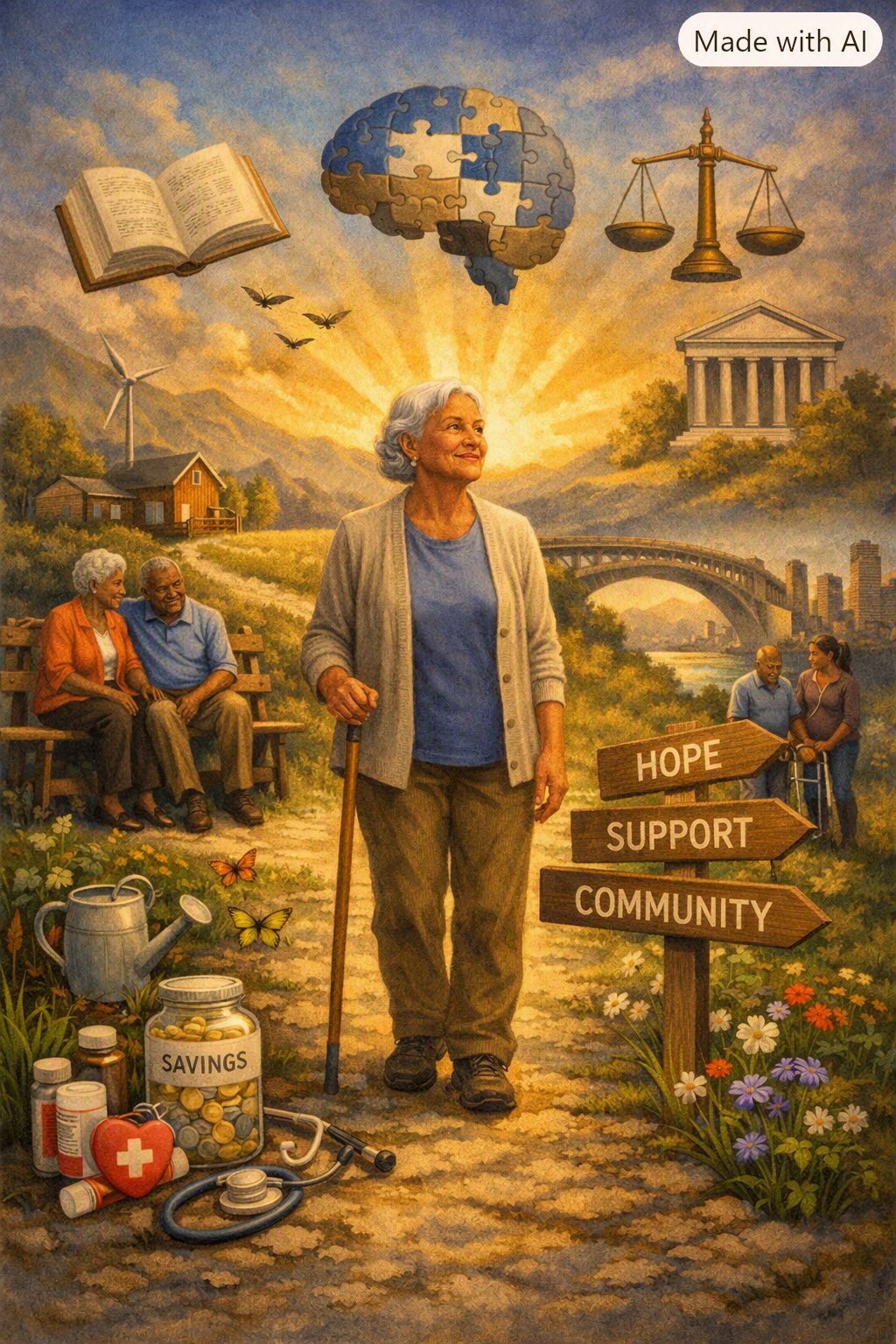

In my Module 1 assignment, the problematic aging situation I feared most was the instability of the systems older adults rely on Social Security, Medicare, long‑term care structures, and the broader economic and political systems that determine whether people can age with dignity. With the way society and economics are shifting, I often wonder how we will reap what we’ve sowed after decades of work. Will the systems we rely on still exist? Will they support us the way they supported generations before us? Imagining myself truly having to face this situation forces me to think deeply about how systemic instability would affect my physical, emotional, social, and financial wellbeing as an older adult.
Physically, weakened aging systems could limit my access to quality healthcare, preventive services, and long‑term care. If Medicare or senior benefits become restricted, I might struggle to afford medical treatment or rely on overburdened public systems. Emotionally, this situation would create anxiety, frustration, and a sense of vulnerability. I would feel the weight of uncertainty, knowing that my wellbeing depends on systems that may not be dependable. Socially, systemic instability could lead to isolation. If community programs, senior centers, transportation services, or social supports are reduced due to policy changes or funding cuts, older adults like me could lose access to meaningful engagement. Financially, the impact would be significant. If Social Security or retirement benefits weaken, I could face insecurity despite a lifetime of work. My initial feelings about this condition are fear, disappointment, and concern not just for myself, but for entire generations who may age in a world that is less supportive than the one before it.
Thinking about this situation also changes the ideal older‑adult life I imagined for myself. In my first blog post, I pictured myself at seventy living vibrantly gardening, raising animals, staying active, traveling, and enjoying a peaceful, self‑sufficient lifestyle close to nature. Systemic instability would shift that picture significantly. If aging systems weaken, I might not have access to the healthcare, transportation, or community resources needed to maintain that lifestyle. My days, which I imagined being filled with creativity, nature, and comfort, might instead be shaped by navigating bureaucratic challenges, advocating for services, or adjusting to reduced support. However, some things would stay the same. I would still want connection, joy, laughter, and meaningful relationships. I would still want to feel vibrant, stylish, spiritually grounded, and full of life. Even if systems change, my desire for purpose and fulfillment would remain.
Using the CARA model of aging helps me think about how I could still achieve resilience even in the face of systemic instability. The CARA model emphasizes General Resistance Resources the strengths, supports, and resources that help people adapt to challenges. At the micro level, my personal GRRs would include my determination, creativity, and ability to plan ahead. I can learn about policy changes, advocate for myself, and make intentional decisions about my future. At the mezzo level, my GRRs would include supportive relationships with family, friends, neighbors, and community networks. Strong social ties can help buffer the impact of weakened systems by providing emotional support, shared resources, and collective problem‑solving. At the macro level, GRRs might include advocacy organizations, community programs, policy protections, and social movements that fight for aging rights. Resilience in this situation would look like staying informed, staying connected, and staying adaptable. It would mean building a life that is sustainable and grounded in community rather than relying solely on systems that may shift or weaken.
Recent research supports these ideas. Johnson and Uhlenberg (2024) argue that the sustainability of Social Security and Medicare depends on policy innovation and intergenerational commitment, noting that demographic shifts will require stronger fiscal planning and political will to maintain benefits. Herd and Moynihan (2023) emphasize that economic inequality and political polarization have widened gaps in aging outcomes, making social policy reform essential to protect vulnerable populations. Zimmerman and Cohen (2025) highlight that clinical and policy interventions in long‑term care systems such as integrated care models and community‑based supports can mitigate the effects of systemic instability by improving coordination and access for older adults.
These studies helped me understand that aging is shaped not only by personal choices but by political decisions, economic trends, and social priorities. They highlight the importance of policy advocacy, community‑based supports, and early planning to protect older adults from systemic gaps. They also emphasize how clinical interventions and long‑term care reforms can strengthen aging systems and improve quality of life for older adults.
Ultimately, imagining myself facing this situation has made me more aware of the importance of long‑term planning, policy awareness, and building strong support networks. While the fear of systemic instability is real, the CARA model reminds me that resilience is not just an individual trait it is shaped by community, culture, and the systems we fight to strengthen. With the right resources, support, and mindset, I can still create a life filled with meaning, connection, and joy even if the systems around me change.
I really liked how you focused on the instability of the systems that older adults depend on, because it’s something that can affect so many different parts of a person’s life. I especially connected with your point about how we can work our whole lives and still be unsure whether Social Security, Medicare, or other resources will be there for us when we need them. I also liked how you connected this to the CARA model and showed that resilience isn’t just about handling things on your own, but also having family, community, and other resources to rely on.
I agree that older people may experience uncertainty due to systemic instability. As systems change, we can remain resilient by developing good relationships, remaining informed, and having community support. Overall a great post!
Thank you! Systems, systems and more about systems! That is exactly where I am why I chose to get into this master’s program. I want to change the system to be more of a help than a hindrance to HUMANS! Between the children and older adults, the latter seem to be more vulnerable now with everything going on in policy and projections. Cutting vital insurances, raising medicine costs and making it difficult for the aging person to just live is problem in this country and to be hones we should be ashamed! We should hold our predecessors to a higher esteem but it is the opposite. It’s like we forget that we must get OLD TOO! Anyway, I did like that you brought it back to why planning makes more sense now. Preparing for the inevitable! That is a friendly reminder for me to do more to be ready for what I know is coming, God Willing! Thanks again for the post!
Monesha,
You do an excellent job of outlining the macro-level concerns that impact older adults. You describe the big three – medical (Medicare), economic (Social Security), and social (Age-friendly development) and you talk about the difficulties the political uncertainty could create. I am impressed, as I teach social welfare policy and spend a lot of time trying to help students understand the relationship between policy and the reality of our lives.
The articles you cite are great discussions of why policy related to older adults is so critical. We will talk a bit about that when we discuss the policy implications of aging. You have identified the political areas that need our focus and reinforced why intergenerational support is so critical. We don’t have much connection between older and younger adults in our country, and the only way to create good policy is for both generations to care about each other’s realities.
I suggest these issues also have micro and personal elements that often aren’t policy-related. Many of the older adults I have worked with would tell you that medical issues are still significant and unrelenting, despite Medicare (maybe the broken health care system is a problem for all of us, no matter our age, right?). Older adults who are living on Social Security are happy to tell you that it is not sufficient to totally answer the economic or financial concerns and needs of most older adults. And the World Health Organization’s idea of “Age-Friendly Communities,” which I hope we will get to in our policy section, is a far cry from how we are building communities presently. You still can’t get anywhere in the city of Atlanta unless you drive – or have a driver – or are young enough to ride a bike on the BeltLine.
I think it is critical we address the policy issues that prevent us from responding to older adults and their needs, and you raise all the important ones. In addition, it’s important we remember that these issues affect people – actual older adults – in real and important ways. The fear of aging is often about how my inability to climb stairs means I can’t get out as much, my kids taking away the keys to my care means I can’t get where I want to go when I want to go there, and my fading memory is leading to my depression and loneliness. Yes, we can make a difference in how we support people by creating effective policies and programs – you are absolutely correct. But in our culture, there is a fear of aging – an avoidance of accepting our own aging – and that creates fears and barriers all on its own. If we can look at what scares us most, we can better understand the older adults we will see in our practice.
Nice job on this post.
Dr P