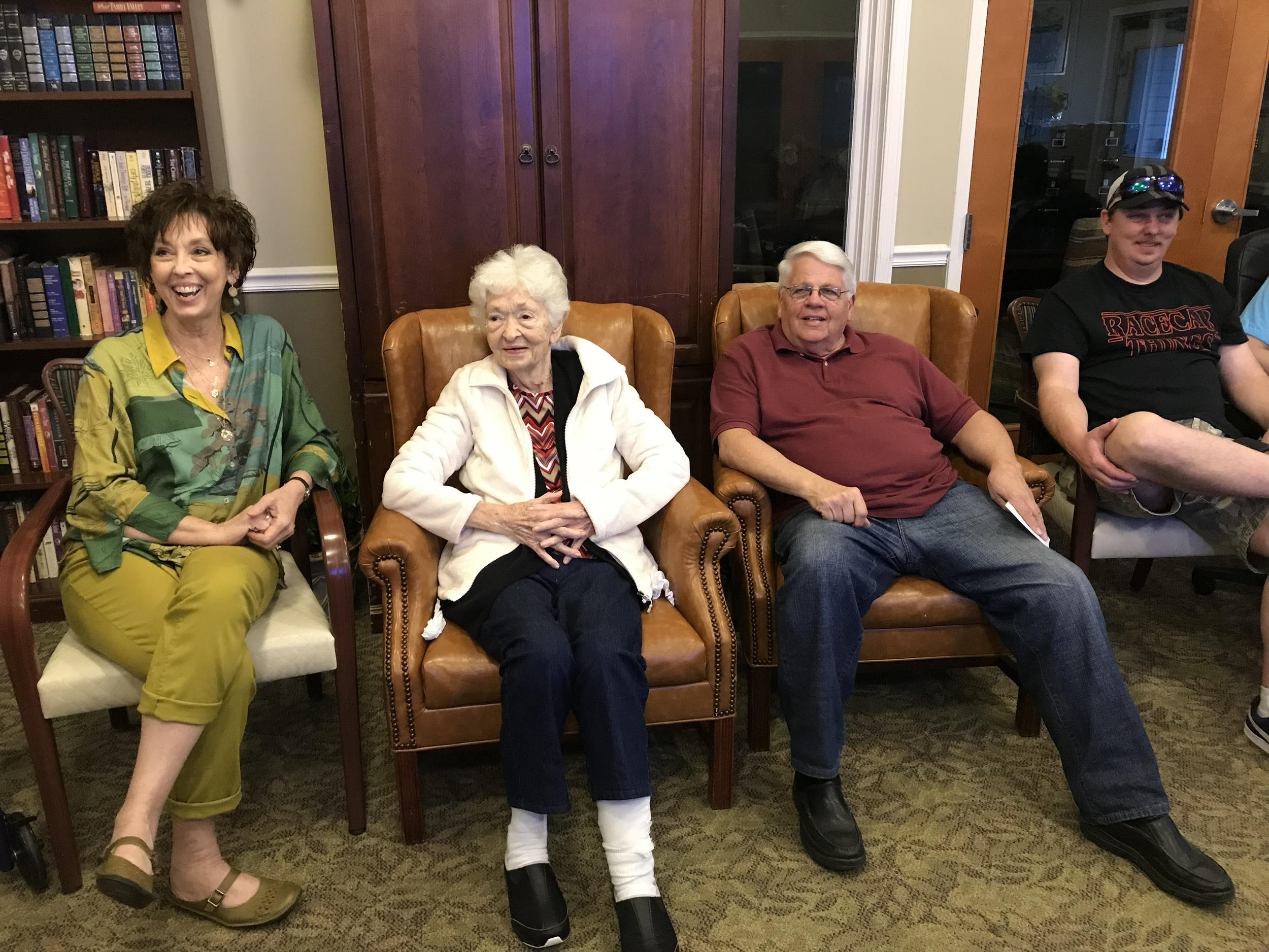

This is a picture of my grandma T’lene, great-grandmother Merle, and other relatives. This was taken at my great-grandmother’s 94th birthday party shortly before she passed away.
In my first blog post, I discussed my fear of possibly getting dementia in older adulthood. Developing dementia, especially in early older adulthood, can severely impact someone’s plans for their future and their families’ plans and finances. Along with cognitive decline, dementia comes with physical decline as well. This creates an even greater need for constant caretaking, which is costly and time-consuming for younger family members who are often in charge of their older relatives’ care. 24/7 care is expensive, and that expense constantly grows year by year. This mostly comes from hospital bills, paying for home caregivers, paying for a day center or residential home, or working fewer hours to support this person with dementia. The emotional toll is intense for everyone involved. There is not a lot of awareness around dementia and what that person is going through. This creates confusion and pain for the person and their family/loved ones.
Developing dementia is a great fear of mine, which is natural. I think it is something that society should become more accustomed to too because as we live longer, there are going to be more people experiencing dementia for longer periods of time. We have seen the effect of this large aging population on society already. I believe that there needs to be more resources put into learning what is truly happening in the brain that is causing these diseases. Though with age there is a natural loss of cognitive ability. However, we still know very little about the diseases that speed up cognitive and physical decline, like Alzheimer’s, Parkinson’s, Huntington’s, etc. I hope that when I am an older adult, society will have improved our knowledge and possibly scientific solutions to cognitive decline. I think that if you have a good environment in your life, not everything has to fall apart when you gain a dementia diagnosis. I hope that my husband and family will support me through that.
After working closely with people experiencing dementia and assisting in my great-grandmother’s care as a teenager, I fully believe that social interaction and comfortable senses for the person are deeply important in their care. Many people struggling with dementia tend to become more reclusive, which can cause depression in older adults. This study on social interactions and the positive effects they have discussed how singing, telling stories, participating in activities, dancing, moving around, etc., can highly increase one’s happiness during this time (Knecht & Rodriguez, 2025). Though this was a smaller study, only including 501 survey participants, it still promises results that I believe could be replicated on a larger scale with the right resources. When speaking of resilience, family/caregiver support is key to ensuring good quality of life for those experiencing this disease. While finances and other resources are needed, as seen through the CARA Model, social support is truly bringing people hope and happiness in confusing and challenging times. Though I do not know much about the clinical side of dementia research, I did find an article discussing recent advances in treating dementia. The article discusses some risk factors such as dementia, being over 65, diabetes, smoking, and depression. In addition to these factors, they state how socioeconomic status and culture have been linked to dementia as well (Hafiz et al., 2023). This is an important article in my opinion, because socioeconomic status and culture are not often linked to how dementia is treated and understood. I will definitely consider these health factors throughout my life and try to maintain a healthy body and mind. However, it really makes you think about how there is a heavy price tag placed on being healthy and having a good quality of life as an older adult.
References:
Hafiz, R., Alajlani, L., Ali, A., Algarni, G. A., Aljurfi, H., Alammar, O. A. M., Ashqan, M. Y., & Alkhashan, A. (2023). The latest advances in the diagnosis and treatment of dementia. Cureus, 15(12), e50522. https://doi.org/10.7759/cureus.50522
Knecht, H. L., & Rodriguez, F. S. (2025). Social interactions in dementia: Perceptions of current situation and opportunities. BMC Geriatrics, 25(1), 202. https://doi.org/10.1186/s12877-025-05850-8
I enjoyed seeing the picture of Grandma T’lene, Great-Grandmother Merle, and your other relatives. Knowing that the picture was taken at your great-grandmother’s 94th birthday party shortly before she passed away makes it even more special. I also think your experience helping with your great-grandmother’s care as a teenager gives you a perspective on dementia that you cannot get just from reading about it in a textbook.
I completely understand why developing dementia is such a fear for you. One thing that really stood out to me in your post was how you talked about dementia affecting not only the person diagnosed but the entire family. Sometimes we focus so much on the cognitive decline that we do not talk enough about what happens to the family members who suddenly become caregivers. Like you mentioned, someone may have to work fewer hours, pay for home care, consider a day program or residential facility, and still deal with the emotional pain of watching someone they love change. That can become overwhelming very quickly.
I also really liked what you said about social interaction. Singing, dancing, telling stories, participating in activities, and simply spending time with someone may seem like small things, but they can mean so much to a person living with dementia. I actually follow a 75-year-old woman on TikTok whose username is Granny Boogie, and she has dementia. Her family takes her to different events so that she can get out, socialize, dance, and enjoy herself. I especially enjoy watching the videos of her dancing in the nightclub. What stands out to me even more than the dancing is the amount of love and respect she receives from the people around her. They do not treat her as if her life stopped because she has dementia. They allow her to continue enjoying herself, being social, and simply living. Watching her makes me think about what you said regarding social interaction and how important it can be for someone living with dementia. A diagnosis may change a person’s life, but it should not automatically take away their joy, dignity, or ability to still have meaningful experiences.
Your point about the “heavy price tag” placed on being healthy as we age really made me think too. We can tell people to eat healthy, stay active, see their doctors, manage chronic conditions, and take care of their mental health, but all of those things require some level of access and resources. Not everyone has the same opportunities to do that. That is why I think your connection between socioeconomic status, culture, and dementia is so important.
Hi Brittany! Thank you so much for the comment. Yes, social interaction is key, or just allowing someone to do things that stimulate them. Brain stimulation is so important during that time in someone’s life. I am lucky that I got to work in an Adult Day Center with a few older women as participants. This allowed us to form a stronger bond and really get to know each other and each other’s lives since there were not 30 people there. So, definitely hard, but something to look into if you are interested.
I don’t know if I have seen them on TikTok; I will have to check that out!
Thank you 🙂
Hi Morgan! I love that you included this photo of your grandmother and that you included parts of your own story in your post. I think having a fear of dementia is completely normal and something that I think about as well with there being a history of it in my family. What you said about her peers is very important, her peers allow her to be herself and recognize the value of this season of her life. It may be different but it is still her life and she deserves to feel free and loved. Such an important concept for us as social workers to bring into practice with all of our clients but especially while working with older adults.
I agree that dementia has an impact on the affected person as well as their family. I liked your comment regarding social interaction because maintaining an active lifestyle and receiving assistance can enhance one’s quality of life. Additionally, your post highlights the need for increased dementia of care knowledge, resources, and research. Great post!
Morgan,
That is a marvelous photo! Having owned a MotoPhoto franchise (think Wolf without the cameras), I have a deep affection for photographs and am often sad when I realize the digital age has led all of us to stop printing photos. There is something about touching a photo that is really cathartic. I realize this photo is probably digital, but it brought to mind so many of the ones that I saw and printed for customers.
Yes, it is true that care as we age can be very expensive. It can also be something totally different, right? I cared for my mother for two years in hospice. That meant the costs of care were lower, but only because my wife, Nancy, supported us while I cared for my mother in our home. Caregiving has many costs, both financial, emotional, and psychological. And not all care is about dementia. Many conditions older adults face are purely physical, but just as care-intensive.
As you read Chapter 3 in Cruikshank, I’d be interested to hear what you think about her assessment of how dementia affects how we think about aging. She confronts some challenges and some myths we have about aging and dementia. Also, I am looking forward to talking with all of you when yo add your thoughts and questions to the podcast with Jim Fox.
I appreciate your comments about social engagement and the study that supports it. One of the things Jim Fox does regularly is perform at senior communities. It is amazing to watch the reactions. Music transports the older adults.
There is definitely an economic divide when we talk about services and options for older adults. Poor folks already suffer from many more of those conditions you mentioned, so it doesn’t surprise me that the prevalence of dementia is also related to economic resources. I hope that when you hear the podcast with Kendall Crye and Zandra Matthews, you hear about ways people build their villages to support them.
Looking forward to the conversations. Thank you for sharing this with us.
Dr P
Hi Dr. P. Thank you so much for the comment. I just finished chapter 4 of the readings, and wow, I really love this book. I definitely want a hard copy. I think a lot of my desire to improve care for older people and those with cognitive decline is just seeing what not labeling someone as “sick” over everything else in their lives can do for someones happiness and their ability to improve. I love how she spoke about older women’s role once they are considered “old”. We often place so many helper and caregiver roles on women, and once they are unable to do that, they fall into the “roleless role” category that she described. Mostly in white American culture.
I love that you mentioned hospice. They can really be a lifesaver for families and people struggling with pain mentally or physically. One thing I hope to do in my career is explain to people what hospice actually does and that it doesn’t mean you are giving up on life. Hospice was with my grandma during her last few years with cancer, and they were so helpful to the entire family.
I am excited to listen to the podcast and I am currently working on Blog Post 3!